The best agronomists in Andalucía do not have time problems. They have scale problems. One skilled agronomist, working hard, can meaningfully serve 20 to 30 farms per season. Not because of their knowledge — that is inexhaustible — but because of the hours. Visiting every farm. Answering every call. Compiling every treatment record. The knowledge scales. The hours do not. Koru exists to change that ratio. Not to replace the agronomist — but to multiply what they can do.
What an Agronomist Actually Spends Their Time On
Ask any agricultural technician working with Spanish cooperatives or farm management companies how they spend a typical week, and you will hear the same answer: more time on paperwork and administration than they would like.
Driving to farms for information they could have received digitally. Helping farmers fill out treatment records that should have been captured at the moment of application. Cross-referencing product codes in the MAPA registry for farmers who do not have access. Compiling data for CAP applications from scattered notebooks, photographs of handwritten pages, and WhatsApp messages.
None of this is agronomic work. It is logistics. And it consumes 30 to 50 percent of the time that could be spent making agronomic decisions.
What Koru Does for the Agronomist
When a farm uses Koru, the agronomist's relationship with that farm changes fundamentally.
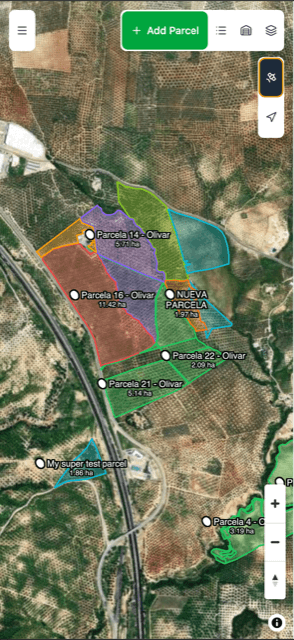
Treatment records arrive structured, not scattered. Every application the farmer records by voice — product, dose, parcela, operator, date — arrives in the agronomist's view as a clean, complete, searchable record. No more photographs of wet notebooks. No more reconstruction at month-end. The agronomist sees what happened on every farm, in real time, from their phone.
MAPA lookups disappear. The system matches every product to its MAPA registration number automatically. The agronomist no longer needs to spend five minutes per treatment helping the farmer find the correct product code. That time is returned to advice.
Certifications alert themselves. ROPO certificates, ITEAF inspections — Koru tracks expiry dates and alerts 60 days before. The agronomist stops discovering expired certifications during inspections and starts being notified months in advance.
Compliance reports write themselves. When inspection season arrives, every farm that uses Koru generates its complete SIEX report in one click. The agronomist is not the one compiling it from disparate sources. They are the one reviewing it.
The result: the same agronomist can serve two, three, or four times as many farms — because the administration that used to consume half their week is handled at the moment of activity, by the farmer, by voice.
The AI as First Line of Response
Koru's AI agronomist handles the questions that do not require expert judgment — and there are many of them.
What is the waiting period for this product on citrus? Is this dose within the authorized range for olive? Which copper-based products are registered for Phytophthora on avocado? These are lookup questions. They have definitive answers in the MAPA database. They do not require a professional agronomist to answer — they require access to the right database and the intelligence to query it correctly.
Koru answers them in seconds, 24 hours a day, from the field, in plain Spanish. The farmer gets an immediate, accurate answer. The agronomist's phone stops ringing for every routine question.
This frees the expert for the questions that genuinely require expert judgment: the unusual disease pressure that does not fit a textbook pattern, the yield variance that points to a soil problem, the rotation decision that will define the next five seasons.
For the Agronomist: A Dashboard, Not a Competitor
A professional agronomist who advises ten farms today can advise thirty with Koru — not because Koru knows their clients better than they do, but because the friction between knowing and recording has been eliminated.
Every farm they advise has clean, complete records. Every treatment has been captured at the moment it happened. Every compliance gap surfaces before inspection day, not during it.
And when they sit down with a farmer for the real agronomic conversation — the one about next season's plan, the soil analysis results, the variety change worth considering — all the context is there. Searchable. Organised. Ready.
Koru does not compete with the agronomist. It is the platform they have always wished their clients were using.
For the Farm: Expert Support, Always Available
For individual farmers who work with an agronomist, Koru extends that support between visits. The AI handles routine questions day and night. The farmer captures every activity correctly — with the right product code, the right dose, the right format — without needing to call their advisor for every entry.
When the agronomist visits, they review a farm that has kept perfect records. Their time is spent advising, not reconstructing.
Conclusion
The constraint on good agronomic advice in Spain is not a shortage of agronomists. It is the administration that prevents their knowledge from reaching more farms. Koru removes that constraint — for the agronomist who wants to scale, and for the farmer who wants expert support between visits.
If you are an agronomist or cooperative technician managing multiple farms: Request a Hub demo →
If you are a farmer who wants expert-quality agronomic intelligence available 24/7: Try Koru free → — Pro Small Farm from €49.90/month. No credit card required.